

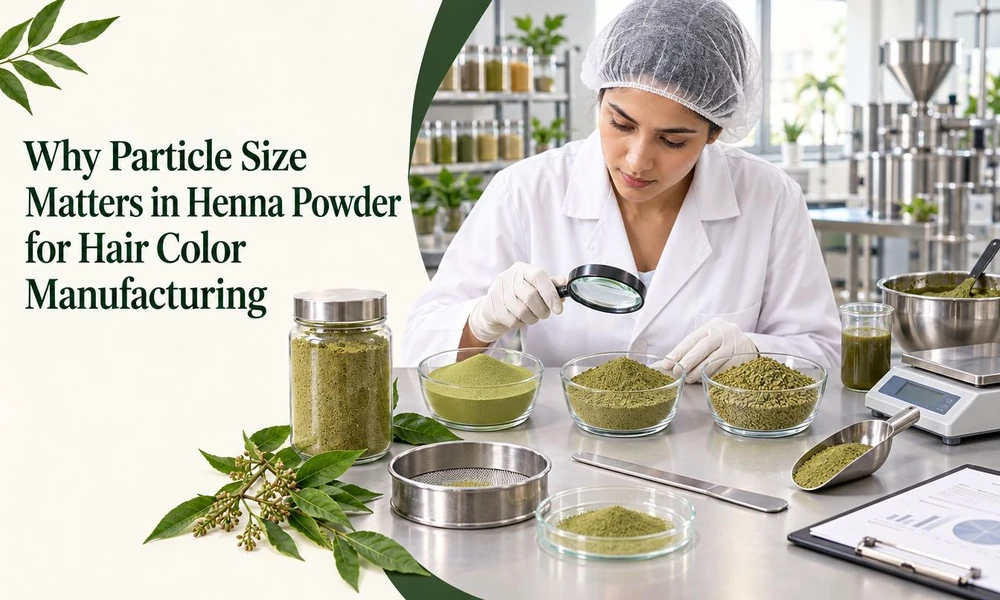
When assessing raw henna, formulators usually start by considering the percentage and source of lawsone, yet one of the most consistent determinants of performance is something easily overlooked. Henna powder particle size affects paste texture, hydration, color deposition, and batch-to-batch consistency during hair-color manufacturing can replicate results across production batches.
Particle Size: The Overlooked Quality Lever
Within cosmetic manufacturing, particle size functions as a quality lever that receives far less attention than it warrants. Two lots with identical lawsone content may behave differently after processing, and buyers sourcing henna powder for cosmetic manufacturing should regard the mesh size as a major factor in quality, criterion rather than a secondary processing detail.
How Mesh Affects Lawsone Release and Dye Uptake
Mesh size governs the surface area available for lawsone to interact with hair keratin during the dyeing process. A well-specified henna mesh size for hair color ensures that pigment release occurs efficiently and predictably, since finer particles expose proportionally more lawsone to the hair shaft within a given application window than coarser material does.
Finer Powder, Faster and Even Color
Finer particles reach the hair surface more uniformly and complete lawsone release within a shorter contact time, which matters for both consumer experience and formulation consistency. Lawsone release henna particle size is highly dependent on particle size; Finer material milled into a more consistent particle size, more uniform grade releases its active dye compound faster and more evenly than coarsely ground powder, reducing the risk of patchy or uneven color results.
Particle Size and Paste Consistency
Size of the particle influences the behavior of the paste when water or any other fluid is added to it. Buyers working with bulk henna leaves powder should insist on particle size documentation besides the other standard specifications, since the grinding process may not be consistent within one batch, it can produce a paste with variable texture that complicates both machine application and manual formulation work.
Smoothness, Application, and Rinse-Out
The smoother paste will spread uniformly, stick in a suitable manner to hair follicles without excessive dripping, and rinses out with less residue left behind. Coarser material tends to leave gritty deposits that require additional rinsing cycles, which affects both the finished product experience and how a formula is perceived relative to competing brands on shelf.
Triple-Sifted vs Coarse Henna
The triple sifting of the henna ensures that it is passed several times through different meshes of increasingly fine size, whereby the coarse fibers and stem fragments are sieved out. Fine sifted henna powder is often used for cosmetic purposes because extra processing step leads to a more uniform distribution of particle size compared to the coarser, less-refined material typically achieves.
Impact on Product Stability and Shelf Life
Stability during storage is affected by particle size as well. Fine powders are denser and more susceptible to moisture absorption, if packaging is inadequate; whereas coarse materials are usually more tolerant in storage but less consistent in performance. The manufacturer should consider both aspects relative to their own storage and distribution conditions.
Balancing Fineness with Cost and Yield
Finer mesh generally costs more to produce and yields less usable material per batch of raw leaf, since additional sifting passes remove more material as byproduct. Brands working with cassia neutral henna leaves as a complementary or diluting ingredient sometimes use this blend to manage cost while maintaining an acceptable particle profile across the finished formulation.
Specifying the Right Mesh for Your Product
Specification should be based on end-use rather than a generic industry default. A manufacturer sourcing bulk henna powder for hair color must determine its mesh specifications depending on whether the product is a paste form, a powder-to-mix format, or a cream-type already blended, since the three forms have different particle distribution tolerance levels.
Typical Cosmetic-Grade Mesh Ranges
Typical cosmetic-grade henna falls within the following mesh ranges depending on application:
- 80 to 100 mesh for standard powder-to-mix hair color formats
- 120 to 150 mesh for premium pastes and cream-based products
- Above 150 mesh for specialty formulations requiring maximum smoothness
- Below 80 mesh generally reserved for non-cosmetic or industrial applications
Other Quality Factors Alongside Particle Size
Particle size is just one aspect of a larger framework of quality, which must not ever be evaluated in isolation. Henna powder dye uptake depends upon the balance between the particle fineness of the henna powder, lawsone content in the powder and moisture content in it, meaning a well-milled batch with low actives still underperforms a coarser batch with higher lawsone content.
Lawsone Content, PPD-Free, Microbial
A complete specification should verify:
- Lawsone content confirmed through laboratory assay, not visual estimation
- PPD-free certification, since some suppliers blend synthetic dyes into raw henna
- Microbial testing results covering total plate count and pathogen screening
Frequently Asked Questions
Q: Why does particle size matter in henna powder?
A: It governs how efficiently lawsone transfers to hair, how the paste behaves during application, and how consistent color results are across production batches.
Q: What mesh size is best for hair-color henna?
A: Most cosmetic-grade hair color formats fall between 80 and 150 mesh, with finer ranges reserved for premium pastes and cream-based products requiring extra smoothness.
Q: Does finer henna always mean better color?
A: Not by itself. Fine particles improve dye release and texture, but color performance also depends on lawsone concentration and moisture content in the batch.
Q: How does particle size affect paste and application?
A: Uniform and finer particles create a more even spread that does not drip or leave behind any residue when rinsed out cleanly. When particles are coarser, they tend to deposit grit in the hair, and require additional extra rinsing and leaving hair feeling less refined.
Q: What else should I check besides mesh?
A: Confirm lawsone content through lab assay, PPD-free certification, and microbial testing results to ensure the batch meets both performance and safety standards.
Sourcing Cosmetic-Grade Henna Powder
The final selection of cosmetic quality henna powder will involve finding the right balance between particle size, potency, and safety documentation as related specifications rather than isolated checkboxes. Consumers who request for complete particle size distribution information in addition to standardized test results are well positioned to predict finished-product performance before committing to a production run.
